Exiting is the hardest thing you can do in markets.
It does not matter if you call yourself an investor or a trader. Finding the setup is rarely the bottleneck. Big reversal candidates stick out. Strong closes that look ready to follow through stick out. Special opportunities stick out.
What quietly wrecks people is deciding when to get out.
Most traders exit on feel.
- The stock is up a lot, so they sell some.
- The stock is not moving, so they get bored and leave.
- They see something on the tape that probably will not matter in a few hours, and they react anyway.
That feels productive. It is not. It creates thousands of tiny discretionary decisions, and those decisions rarely compound into a consistent process.
What usually happens instead:
- They sell too soon.
- Or they hold too long.
- They are never consistent with either.
Inconsistent exits create inconsistent results. You can look green for a week and still bleed over the month, the quarter, and the year. After enough of those years, it starts to feel like the whole game is broken.
It is not. Your exit process is.
There is a cleaner approach: time-based exits.
What Time-Based Exits Actually Are
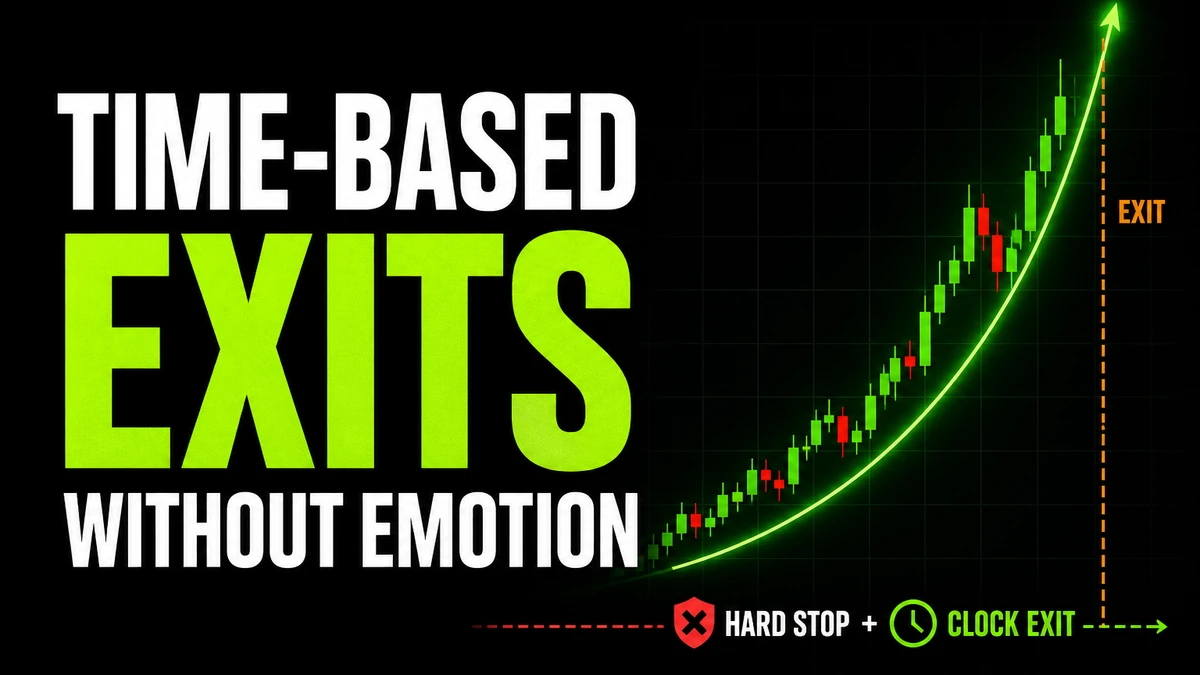
A time-based exit means your default way out is a clock, not a vibe.
You decide in advance:
- When you get in
- Where your hard stop lives
- When time takes you out if the stop has not already
You are no longer being dictated by every tick, every bounce, or every story you invent while you are in the trade.
Your exit is mechanical.
That does not mean you abandon risk management. It means you stop letting emotion be the risk manager.
A Simple Overnight Momentum Framework
One of the cleanest examples is overnight momentum.
You buy into the close. Then you choose a time-based exit:
- Sell on the next open
- Or hold into the next close
You can even run both versions if you want clean comparison data. One book sells on the open. Another holds to the close. Both use the same hard stop, often something simple like the low of day from entry.
That structure does a lot of work for you:
- You define risk before the trade starts.
- You define the hold period before the trade starts.
- You stop inventing new rules mid-trade.
You put the position on. The stop protects you. Time gets you out. That is the whole job.
You can also use a set clock during the day if that matches your edge. The principle stays the same. The exit belongs to the plan, not to your mood at 11:40 a.m.
Why This Creates Asymmetric Upside
Feel-based exits are especially expensive on the rare winners.
Imagine you buy a small cap at $1. The next morning it is $2. Every emotional bone in your body wants to sell. You are up 100%. It feels smart. It feels responsible. It feels like locking in a win.
Then the stock keeps going.
Maybe it is the black swan that goes parabolic. Maybe it is $10 by lunch. Maybe it is $50 over the next session or two.
If your plan was "sell when it feels like a lot," you got paid for being early and emotional. If your plan was "hold until the next close unless stopped," you stayed positioned for the move that actually matters.
That is the point of time-based exits.
They do not make every trade better. They make your process open to the outliers that carry a year.
Most traders over-optimize the average winner and under-participate in the extraordinary one. Time-based exits flip that. You accept ordinary noise, occasional round trips, and the discomfort of watching a big open gain give some back, in exchange for staying alive for the move that changes the distribution.
Asymmetry is not a slogan. It is what happens when your losers stay defined and your winners are allowed to become unusual.
Pair Time With a Hard Stop
Time-based does not mean unprotected.
A hard stop still matters. For many overnight or momentum frameworks, a low-of-day stop is clean and objective. You always know the invalidation. You always know the risk. You are not "giving it room" based on hope.
That combination is powerful:
- Hard stop caps the downside
- Time exit removes discretionary profit-taking
You are not babysitting every candle. You are enforcing a rule set.
The Tradeoffs You Have to Accept
Time-based exits are not magic. They have real cons.
Because you are not using discretion, some trades will look great early, reverse, and stop you out. You will round-trip positions that felt locked in. You will leave money on the table on days when selling into strength would have felt brilliant in hindsight.
That is the cost of admission.
The pro side is bigger if your edge is real:
- You open yourself up to asymmetric upside
- Your exit is time, not chart storytelling
- You reduce the number of emotional decisions you make every day
- You can actually have a life outside the screens
That last point is underrated. If every open position requires constant micro-management, trading starts eating your entire day. A planned time exit lets you keep a career, train, eat lunch without doomscrolling Level 2, and still run a serious process. I have written before about why that outside structure matters in Should I Even Trade Full Time? and The Realistic Path to Wealth as a Trader.
Backtesting Is Not Optional
Do not adopt time-based exits because they sound disciplined.
Adopt them because your data says the hold period has edge.
You need evidence for questions like:
- Does selling on the open beat holding to the next close for this setup?
- What happens if the stop is low of day versus a fixed percentage?
- Does the edge survive costs, slippage, and boring market regimes?
- Are the big winners frequent enough, and large enough, to justify the round trips?
Without that, you are just swapping one superstition for another.
If you need a practical workflow for testing rules, start with How to Backtest Trading Strategies in Trade Ideas. Then journal the live version so your actual exits match the tested plan. Tools like Tradervue and TradeZella make it obvious when you are still leaking P&L through discretionary overrides.
A Practical Checklist
If you want to implement this without turning it into a philosophy project, keep it simple:
- Define the setup in one sentence. If you cannot, you do not have a setup.
- Define the stop before entry. Prefer objective levels over "I'll know."
- Define the time exit before entry: next open, next close, or a fixed clock.
- Size for the stop, not for the fantasy target.
- Do nothing discretionary unless the stop or time exit hits.
- Review weekly: did you follow the exit, and what did overrides actually cost?
Also be selective about where you apply this. Time-based holds work a lot better in names that can actually move and that you can exit cleanly. If you are still forcing illiquid garbage, fix that first. Only trade stocks that are actually in play.
Who This Is For
Time-based exits are especially useful if:
- You keep selling winners the moment they feel "enough"
- You constantly renegotiate your plan while in a trade
- Your best ideas never show up in your P&L because you cut them early
- You want fewer decisions and more repeatability
- You trade around a job and cannot babysit every position
They are less useful if your proven edge depends on active intraday management, auction reading, or scaling around very short-lived dislocations. In that case, your exit language may need to be price and tape, not the clock. The goal is not to worship time. The goal is to stop improvising.
Final Thoughts
Entries get all the attention because entries feel smart. Exits get ignored because exits feel emotional.
If your process is held together by feel, you will keep getting inconsistent results no matter how good you are at spotting opportunity.
Time-based exits give you a way out that is boring, repeatable, and open to upside you cannot predict in the moment. Combine them with a hard stop. Demand backtested evidence. Accept the round trips. Then let time do what your emotions keep interrupting.
That is how you stop needing to be a hero on every exit, and start building a process that can actually last.
Next step: If you want the tools that make mechanical trading easier to test and review, browse the current discounts on SaveOnTrading deals. Start with scanners and journals before you buy another indicator pack.
This is educational content, not financial advice. Trading involves substantial risk of loss.